
8.7 Agentic RAG - Multi-Agent
RAG Cheatsheet

Multi-Agent RAG
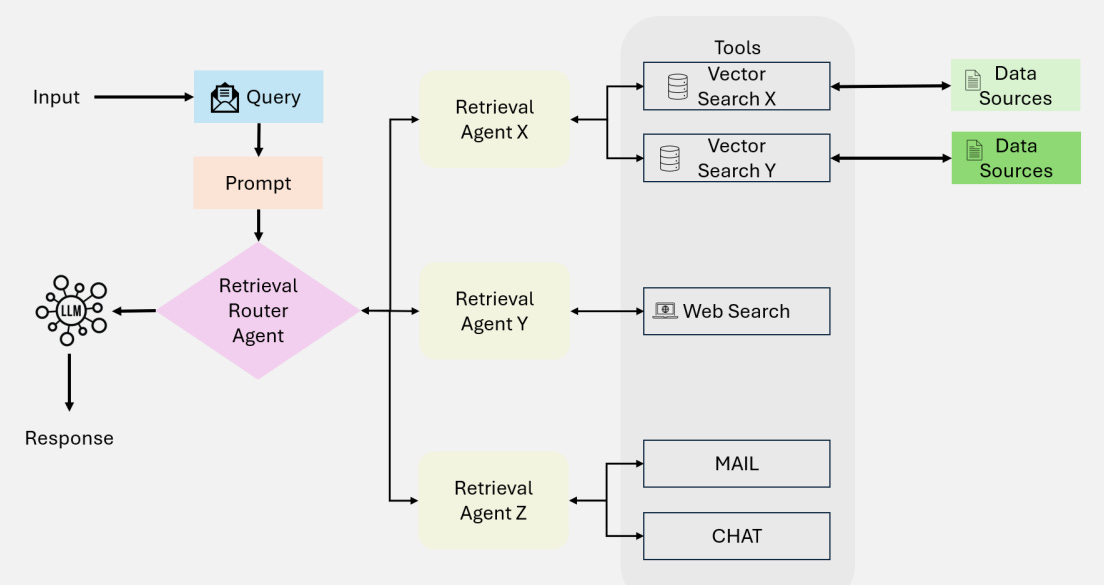
Core Concept: This architecture moves beyond a single agent, distributing tasks across multiple specialized agents. This modular approach enhances scalability, efficiency, and adaptability.
Workflow:
Query Distribution: The system receives a user query and a central "coordinator agent" analyzes it. This coordinator then intelligently delegates the query to relevant specialized agents based on the query's nature and complexity.
Specialized Retrieval:
Agent Specialization: Each agent focuses on a specific task or data source:
Agent 1: Handles structured queries (e.g., SQL queries to databases).
Agent 2: Performs semantic search on unstructured data (e.g., documents, articles).
Agent 3: Retrieves real-time information from the web.
Agent 4: Provides personalized recommendations.
Parallel Processing: Agents work concurrently, enabling faster retrieval of information from diverse sources.
Data Integration: The retrieved information from all agents is consolidated.
LLM Synthesis: The LLM processes the integrated information, synthesizes a coherent response, and addresses the original query.
Output Generation: The system presents the final response to the user.
Key Advantages:
Modularity: Easy to add or remove agents as needed, adapting to evolving requirements.
Scalability: Parallel processing by multiple agents enhances performance and allows for handling high query volumes.
Efficiency: Task specialization improves accuracy and minimizes bottlenecks.
Versatility: Suitable for a wide range of applications, from research and analytics to complex decision-making.
Usecase : Multi-Domain Research Assistant
Query : What are the economic and environmental impacts of renewable energy adoption in Europe?
1. System Process (Multi-Agent Workflow):
Agent 1: Retrieves statistical data from economic databases using SQL-based queries.
Agent 2: Searches for relevant academic papers using semantic search tools.
Agent 3: Performs a web search for recent news and policy updates on renewable energy.
Agent 4: Consults a recommendation system to suggest related content, such as reports or expert commentary.
Response:
Integrated Response: “Adopting renewable energy in Europe has led to a 20% reduction in greenhouse gas emissions over the past decade, according to EU policy reports. Economically, renewable energy investments have generated approximately 1.2 million jobs, with significant growth in solar and wind sectors. Recent academic studies also highlight potential trade-offs in grid stability and energy storage costs.”
Challenges:
Coordination Complexity: Managing communication and task delegation between multiple agents requires sophisticated orchestration mechanisms.
Computational Overhead: Parallel processing can increase resource consumption.
Data Integration: Seamlessly combining and synthesizing information from diverse sources can be challenging.
In summary, Multi-Agent RAG offers a more sophisticated and scalable approach to RAG by distributing tasks across specialized agents. This modular architecture enhances efficiency, adaptability, and the ability to handle complex, real-world scenarios.